
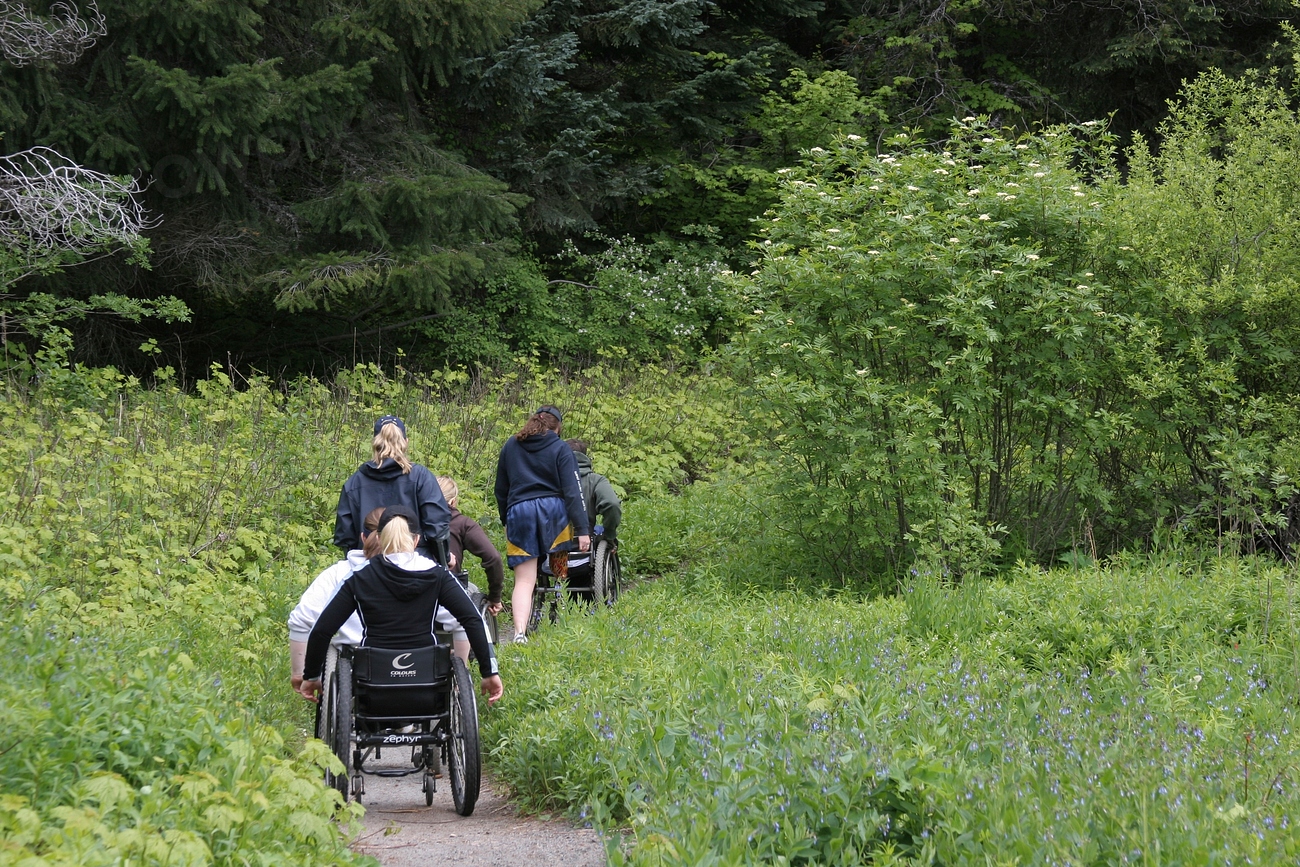

The Outdoors Is Rarely Inaccessible by Nature
A forest does not exclude anyone. A curb does. A missing sentence on a website does. A three-inch lip at a trailhead gate, a program that assumes everyone drives, a group leader who never states the actual distance — those are the things that decide who gets to be outside, and every one of them is a design decision made by a person. That is the useful reframing: accessibility is not a feature of a landscape or a limitation of a body. It is a property of how an activity was built.
Roughly one in four American adults lives with a disability. Add the people with temporary injuries, chronic pain, cardiac and respiratory conditions, sensory differences, and the ordinary changes of aging, and the group that benefits from thoughtful design is not a minority carve-out. It is most of the community at some point in life. Programs that get this right do not run a separate accessible option on the side. They build one activity that more people can join.
Start With Information, Because It Costs Nothing
The single most requested improvement from disabled outdoor participants is not new infrastructure. It is accurate information. People make their own decisions well when they have real data, and they are shut out when descriptions are vague, optimistic, or missing.
The word accessible on its own is close to useless. It might mean a paved loop with a level parking area and an accessible restroom, or it might mean a gravel path with a fourteen percent grade that someone once rolled up successfully. Specifics let a person decide for themselves, which is the entire objective.
- Publish surface and width. State whether the path is asphalt, compacted crushed stone, boardwalk, dirt, or loose gravel, and give the narrowest point in inches, because that number determines whether a wheelchair or an adaptive cycle fits at all.
- Give real grade figures. Say the steepest sustained grade and how long it runs; gently rolling means nothing, while a stretch of eight percent for two hundred feet is a decision someone can actually make.
- Describe the obstacles by name. Roots, steps, gates with turnstiles, water crossings, and drop-offs belong in the description, listed individually, not summarized as some uneven sections.
- Locate the fixed points. Parking, restrooms, benches, water, and shade with their distances along the route let someone plan rest and manage fatigue, pain, or a bathroom-dependent condition.
- Say what is missing. Being honest that a trail has no accessible restroom or no bench in the first mile is far more respectful than omitting it and letting someone discover it two thirds of the way around.
Designing Activities That Do Not Need a Separate Version
Segregated programming tends to be under-resourced, scheduled at inconvenient times, and quietly canceled first. It also removes the reason many people show up, which is to be with everyone else. A stronger approach is to design the main activity with enough flexibility that participation is a matter of choosing your own level rather than joining a different group.
Build in multiple valid distances
A route with a marked half-loop, a designated turnaround point, and a regroup at the end lets people cover different distances and still finish together. Nobody has to declare a limitation in advance or ask for an exception, which removes the social cost that keeps people home.
Set pace by the group, not the front
The convention of waiting at every junction and never leaving anyone alone changes who can participate more than any equipment purchase. It also improves the experience for everyone, since a group that regroups is a group that talks.
Make the meeting point genuinely reachable
Check that the gathering spot has accessible parking near the start, a level surface to stand or roll on, and a route from any transit stop that does not involve a missing sidewalk. A perfectly accessible trail behind an inaccessible parking lot is not accessible.
Offer sensory-aware options
For participants with sensory processing differences, autism, or anxiety, the useful accommodations are predictability and quiet: a published schedule of what will happen and when, a clear plan for how to leave early without a fuss, and at least some outings that avoid crowds, loud equipment, and unstructured chaos.
Equipment That Opens Terrain
Adaptive equipment has improved dramatically and is more available than most people realize, often through loan programs, state parks, or nonprofit lending libraries rather than purchase.
- All-terrain wheelchairs. Balloon-tired manual and powered chairs handle sand, snow, and rough trail that a standard chair cannot, and many park systems now lend them free with a reservation.
- Handcycles and recumbent trikes. These open up paved and hard-packed trail networks for people who cannot use a standard bicycle, and recumbent trikes also solve balance problems for many older riders.
- Adaptive paddling gear. Outrigger stabilizers, seat backs, and modified paddle grips make kayaking and canoeing workable for a wide range of trunk stability and grip strength.
- Trekking poles and hiking chairs. Poles reduce joint load and improve stability for anyone with pain, fatigue, or balance issues, and lightweight portable seats make longer outings possible by allowing frequent rest.
- Trail-rider carts. Single-wheeled chairs pushed and steered by a small team let people access backcountry trails, and they are typically run through outdoor clubs rather than owned individually.
Equipment is only half the equation. A loaner all-terrain chair sitting in a shed that nobody advertises helps no one, and programs consistently underestimate how much promotion these resources need.
Language, Assumptions, and How To Not Get It Wrong
Most awkwardness in this area comes from good intentions applied without asking. A few practical norms cover nearly all of it.
Ask before helping, and accept the answer. Grabbing a wheelchair, taking someone’s arm, or moving a mobility aid without permission is both unsafe and rude, and a person who declines assistance has usually solved this exact problem hundreds of times. Speak to the person, not to a companion or interpreter. Do not offer praise for ordinary participation; someone who came out for a two-mile walk came for the walk, not to be called inspiring for it.
On terminology, disabled people are not in agreement with each other, and that is fine. Some prefer identity-first language, some prefer person-first, and the practical rule is to follow whatever the individual uses about themselves. Avoid euphemisms like differently abled and special needs, which most disabled adults find patronizing. If you get a word wrong, correct it briefly and move on rather than turning it into an event.
Above all, avoid making assumptions about capacity based on appearance. Many disabilities are invisible, energy levels vary day to day, and the person using a mobility aid on Tuesday may not need it on Thursday. That is normal, not suspicious.
Fixing the Small Barriers You Already Control
Organizations often assume accessibility requires capital projects. Much of it does not. A meaningful share of the barriers in local outdoor programming are procedural and can be removed this month at no cost.
- Remove the mandatory phone step. Requiring a phone call to register excludes deaf and hard-of-hearing participants and many with anxiety; an email or web form should always be an alternative.
- Add captions and alt text. Captioning program videos and writing image descriptions on your site takes minutes and makes your information usable by people who are currently locked out of it.
- Prop the gate. Narrow turnstiles, chained gates, and bollards installed to stop motorbikes routinely block adaptive cycles and wheelchairs, and many can be adjusted or unlocked on request.
- Ask on the sign-up form. A simple open question about what would make participation easier, with a real person reading the answers, surfaces cheap fixes you would never have guessed.
- Train the volunteers. Thirty minutes on etiquette, guiding techniques, and how to describe a route accurately changes the experience more than most equipment budgets do.
Bringing Disabled Participants Into the Planning
The persistent failure in accessible outdoor programming is that it gets designed by non-disabled people who guess. Guessing produces ramps that end in gravel, accessible restrooms locked outside business hours, and beautifully built boardwalks with no accessible parking within a quarter mile.
The fix is unglamorous: put disabled people on the planning committee, pay them for consulting work as you would any other expert, and hire them as staff and trail leaders. Local independent living centers, adaptive sports organizations, and disability advocacy groups are usually willing partners and know exactly which local trails work and which do not.
Then check the work in the field. Walk and roll the route yourself with the people who will use it, measure the tight spots, and fix what you find. A trail assessment done in person surfaces more real problems in one afternoon than a year of well-meaning meetings.
What Success Looks Like
You will know a program is working when nobody has to call ahead to ask whether they can come. When the route description is detailed enough that people self-select confidently. When the group waits at junctions as a matter of course. When the adaptive equipment is booked most weekends because people know it exists. When disabled participants show up as leaders, not only as guests.
None of that requires a grant cycle to begin. It starts with measuring a trail honestly, writing down what you find, and asking the people who use it what would help. The outdoors was never the obstacle. Everything between a person and the trailhead was built by someone, which means it can be rebuilt by someone too.
