
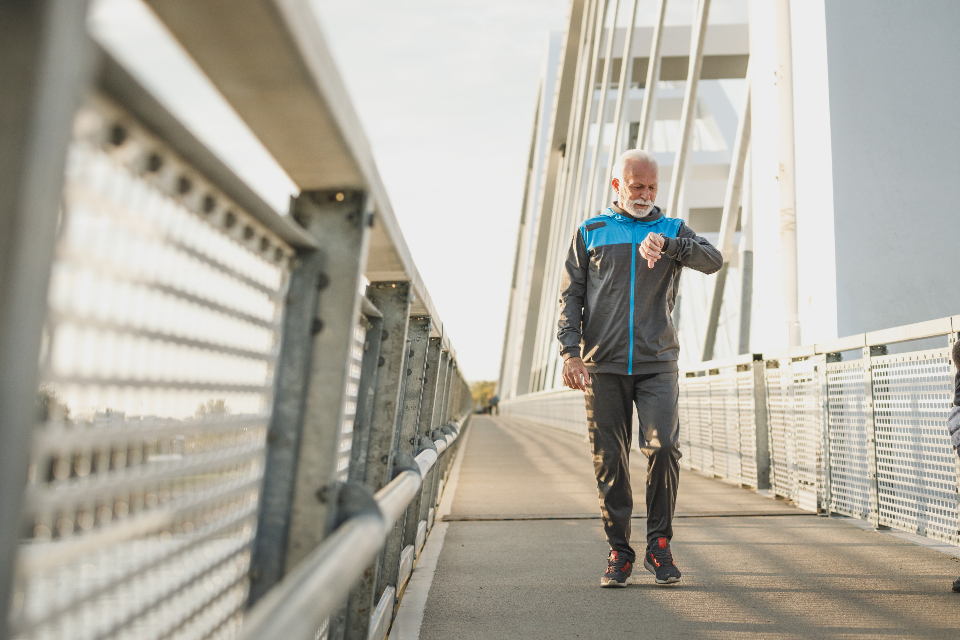

Fitness After Sixty Is About Capability, Not Nostalgia
The most useful question an older adult can ask about exercise is not how much they used to be able to do. It is what they want to still be doing in ten years. Carrying a grandchild. Getting a suitcase into an overhead bin. Walking the dog on an icy morning without fear. Climbing the stairs at a friend’s house without planning the whole visit around them. Those are the outcomes that training protects, and outdoor activity is one of the most effective and least complicated ways to protect them.
Outdoor fitness for older adults tends to get discussed in two unhelpful ways. One version is a warning label — be careful, take it easy, do not overdo it. The other is a highlight reel of seventy-year-old ultramarathoners that makes everyone else feel hopelessly behind. The realistic middle is far more interesting: a steady, unglamorous practice built on walking, resistance work, balance, and time outside, adjusted for whatever the body is currently dealing with. It works, it repeats well, and it requires no gym membership or lifetime of athletic history.
What Actually Changes With Age, and What Does Not
Some physical changes are real and worth planning around. Muscle mass declines gradually from midlife onward if it is not actively defended. The balance systems get less sharp. Bone density drops, particularly after menopause. Recovery from hard efforts takes longer, and connective tissue is less forgiving of sudden jumps in training load. Reaction time slows a little. These are facts rather than opinions, and pretending otherwise is how people get hurt.
What does not change is the body’s response to training. A seventy-five-year-old who starts lifting gets stronger. A sixty-eight-year-old who starts walking regularly improves aerobic capacity within weeks. Balance improves with practice at any age. The adaptations may arrive at a slightly different pace, but they arrive, and in many cases the relative gains are larger than in a younger person simply because there is more room to improve.
- Strength is the priority. Of everything that declines with age, muscle loss has the clearest link to losing independence, and it is also the most reversible with consistent resistance work two or three times a week.
- Balance is trainable. Standing on one leg while brushing teeth, walking on uneven ground, and practicing turns and direction changes all build the systems that prevent falls, and none of it costs anything.
- Recovery needs respect. The old pattern of hard effort every single day tends to break down; alternating harder and easier days produces better results and far fewer setbacks.
- Consistency beats intensity. Four moderate sessions a week for a year will do more for real function than a heroic three-week burst followed by a strained calf and two months on the couch.
Walking, Reconsidered as Real Training
Walking gets dismissed as too easy to count. That is a mistake, and it is usually made by people walking flat ground at conversational pace. Walking becomes genuine training the moment you add variables: hills, uneven surfaces, a loaded backpack, brisker pace for short stretches, or simply more duration than the body is used to.
Add hills before you add speed
Uphill walking raises heart rate and loads the legs without the impact that bothers arthritic knees. It is one of the most joint-friendly ways to build aerobic fitness that exists. Downhill sections train eccentric strength, which is precisely the quality that helps someone control a stumble instead of falling. Start with gentle grades and short segments, and let the body adapt across weeks rather than days.
Carry something
A backpack with eight or ten pounds turns an ordinary walk into a loaded carry, strengthening the trunk, the hips, and the grip. Load carrying maps directly onto real life — groceries, luggage, a bag of soil for the garden bed. Build up slowly, keep the weight high and close to the back rather than swinging from one hand, and treat it as training rather than errand-running.
Walk on ground that is not flat
Grass, dirt trails, gravel, and gently root-crossed paths force constant small ankle and hip corrections. That is balance training disguised as a walk. Choose ground that challenges without being genuinely treacherous, and use trekking poles if they are what make the harder surfaces accessible.
Strength Work That Happens Outside
Resistance training does not require a rack of dumbbells. A park bench, a sturdy railing, a set of stairs, and body weight cover most of what an older adult needs, and doing it outdoors removes the intimidation factor that keeps a lot of people out of gyms entirely.
- Sit-to-stand from a bench. The single most functional lower-body exercise there is; three sets of eight to twelve, eventually without pushing off with the hands, directly protects the ability to get out of a chair, a car, or a bathtub.
- Step-ups on a low stair. Working one leg at a time builds the hip strength that keeps gait steady, and the height scales from a curb to a full stair as capacity grows.
- Incline push-ups on a railing. Upper-body pushing strength at whatever angle the body can handle today, with difficulty dialed simply by moving the feet closer to or farther from the rail.
- Farmer carries. Pick up something heavy in each hand and walk fifty steps; grip strength is among the strongest predictors of long-term health outcomes and this trains it directly.
- Calf raises on a curb. The calf is both the shock absorber and the push-off engine of walking, and it is chronically undertrained in anyone who has become sedentary.
Two sessions a week is enough to produce real change. Three is better. The load should feel difficult by the last two or three repetitions but never so heavy that form collapses or breathing gets held.
Balance and Fall Prevention Without the Fear
Fall prevention is often taught in a way that increases anxiety, and anxious walking is unsteady walking. A better framing is that balance is a skill being practiced, the same way anyone practices a skill: at the edge of current ability, with a safety net, on a regular schedule.
Practical balance work looks like standing on one foot next to a fence you could grab, walking heel to toe along a line in the grass, stepping over low obstacles, and turning the head side to side while walking. Each of those challenges a different part of the balance system. Ten minutes, three times a week, produces measurable improvement within a couple of months.
Two things deserve honest attention. First, medications matter — blood pressure drugs, sedatives, and several common prescriptions affect steadiness, and a conversation with a doctor or pharmacist about fall risk is a legitimate part of a fitness plan, not an admission of frailty. Second, vision and footwear matter enormously. Worn-out shoes with compressed soles and slick tread undermine everything else, and a current eyeglass prescription is a balance intervention.
Heat, Cold, and Reading the Weather Honestly
Older bodies regulate temperature less efficiently. Thirst signals weaken, sweating starts later, and cold penetrates faster. None of that argues for staying indoors; it argues for adjusting the plan around the conditions.
- Front-load the day in summer. Morning outings before the heat builds are safer and more pleasant, and drinking on a schedule rather than waiting for thirst compensates for a blunted thirst signal.
- Layer generously in winter. Hands, ears, and feet lose heat fastest; a warm hat and real gloves are often the difference between a pleasant walk and a decision never to try winter again.
- Respect ice absolutely. Ice is the one condition where the right answer is usually to move indoors, because a fall on ice can undo a year of progress in a second; traction cleats help, and caution helps more.
- Know the stop signs. Dizziness, confusion, chest discomfort, unusual shortness of breath, or a sudden loss of coordination mean stopping immediately and getting help, not pushing through to finish the loop.
Doing It With Other People
The social side is not a pleasant extra. Isolation is a genuine health risk for older adults, comparable in impact to several well-known physical risk factors, and group outdoor activity addresses both problems in the same hour. A walking group, a community garden shift, a pickleball morning, or a trail-cleanup crew delivers movement and company together.
Group activity also builds in a safety layer. Someone notices when a regular does not show up. Someone is there if a knee gives out a mile from the parking lot. Someone knows who to call. That informal watchfulness is one of the strongest practical arguments for training outdoors with others rather than alone.
For anyone restarting after a long gap, the group is also the accountability that makes week three happen. Motivation is unreliable and always has been. A standing commitment to people who expect you is considerably more durable than a resolution.
Building a Week That Holds Up
A realistic week for someone in reasonable health might look like this: three walks of thirty to fifty minutes, two of which include hills or uneven ground; two strength sessions of twenty minutes built from the movements above; balance practice folded into daily routines at the sink and on the stairs; and one longer, slower outing on the weekend that is as much about being outside as about training.
That is roughly three to four hours across a week, and it covers aerobic capacity, strength, balance, and time outdoors. It can be halved and still produce real benefit. The scaling that actually matters is not the total hours but whether the plan survives contact with a busy month, a sore knee, or a two-week cold snap.
Anyone managing a heart condition, uncontrolled blood pressure, a recent surgery, or a joint replacement should get specific guidance before starting, and a physical therapist is often a better source than a general recommendation. That is not a reason to delay by a season. It is a reason to get the plan right the first time, and then to hold on to it for the next twenty years.
