

The First Hour Decides Everything
Most people who never take up fishing were put off in the first hour. They were handed a rod they did not understand, driven somewhere remote, told to be quiet, and left in the cold for four hours without catching anything. Then somebody asked whether they enjoyed it.
Fishing is a wonderful thing to share, and very easy to share badly. The core mistake is treating the first session as a fishing trip that happens to include a beginner, rather than an introduction that happens to include fishing.
This is a guide to doing it the other way round.
Plan the First Session Around the Person, Not the Fish
A good first hour has a few unglamorous features. It is close to the car. There is somewhere to sit and a bathroom within reach. It happens where the fish are small, plentiful and unfussy rather than rare and difficult.
Small fish beat big ones
Small fish are the entire point. A beginner who catches six little sunfish or perch has had a wonderful morning. A beginner who spends five hours waiting for something impressive has learned that fishing is boring, and that lesson is very hard to undo. Ponds, small lakes, canals, and gentle stretches of river are far better teachers than anywhere ambitious.
Stop too early
Keep it short. Ninety minutes is plenty for a first session, and stopping while somebody still wants to continue is the single best thing you can do for their interest. If they ask when you are going again on the way home, you got it right.
The Minimum Tackle
Fishing tackle is a hobby of its own, and it can be ignored almost entirely at the start. What you need is a rod that casts easily, a hook small enough for a small mouth, and a way of seeing when something is happening.
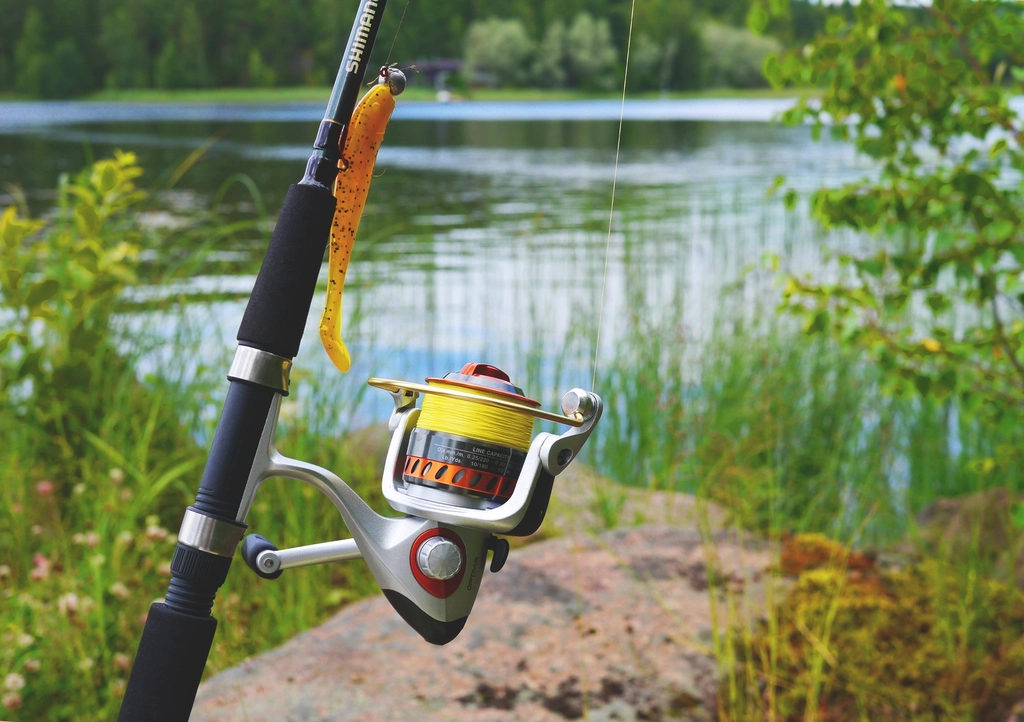
- One simple rod and reel. A short, light spinning rod or a basic closed-face reel is far easier for a beginner than anything longer or more technical. Combination kits sold for beginners are perfectly adequate and cheap.
- Small hooks. Most beginners fish with hooks that are far too big. A small hook catches many more fish, and a barbless hook, or one with the barb pinched flat with pliers, comes out of a fish — or a finger — much more easily.
- A float and a couple of split shot. A float turns an invisible activity into a visible one. Watching something bob is what holds a child’s attention through a slow spell.
- Bait that is easy to handle. Worms, sweet corn, or bread work on a great many freshwater species. Buy or dig it beforehand so nobody is standing around while you improvise.
- Pliers or forceps, and a damp cloth. Forceps get a hook out quickly, and a wet cloth or wet hands protect a fish you intend to release.
- A landing net if the fish might be more than tiny. Lifting a fish out on the line risks losing it and injuring it.
You do not need a tackle box, a chair system, six rods, or a fish finder. Borrow gear from your group or a friend for the first few outings before anybody buys anything.
Licenses and Local Rules
Fishing is regulated, and the regulations differ from place to place in ways that catch out newcomers and lapsed anglers alike.
The license
In the United States, freshwater and saltwater fishing licenses are issued at the state level. Requirements, prices, age exemptions, and the definition of what counts as fishing all vary between states, and a license from one state generally does not cover you in another.
The rules of the water itself
Beyond the license, individual waters carry their own rules. Seasons may be closed for part of the year. There are often size limits and daily catch limits for particular species. Some waters are catch-and-release only. Some prohibit live bait, or lead weights, or fishing at night. Private and club waters have their own permits entirely, separate from any state license.
- Check the state agency first. Every state publishes current regulations and sells licenses, usually online, and that is the authoritative source rather than anything you read secondhand.
- Then check the specific water. Signage at the access point, the managing agency, or the club will tell you what applies there. It can differ from the general state rules.
- Sort licenses before the day. Standing in a parking lot with a phone and a bored eleven-year-old while you try to buy a license is a poor start.
- Check the age rules. Many states do not require a license below a certain age, but the accompanying adult usually does need one.
- Ask when unsure. Wardens and local anglers are generally happy to explain rules to somebody who is visibly trying to follow them.
Handling Fish Properly
How you handle the first fish teaches your beginner what kind of angler they are going to be. Do it carefully and narrate what you are doing.
- Wet your hands first. Dry hands remove the protective slime coating that helps a fish resist infection. Wet hands, or a wet cloth, do far less damage.
- Support the body, do not squeeze. Hold a fish horizontally with a hand under the belly rather than dangling it vertically by the jaw, which can strain the fish’s internal structures.
- Keep it out of the water briefly. Seconds, not minutes. Have the camera ready before the fish comes out, not after.
- Use forceps for the hook. If a fish is hooked deeply and the hook cannot be removed easily, cutting the line close to the hook usually gives the fish a better chance than digging for it.
- Release it gently. Hold it upright in the water until it swims off under its own power. Do not throw it back.
- Decide in advance if you are keeping fish. If you are, know the size and bag limits and dispatch the fish quickly and humanely rather than letting it suffocate in a bucket.
Watch fingers as well. Many species have sharp spines in their fins or teeth worth respecting, and hooks in fingers are a common and unpleasant injury. If a hook goes in past the barb, do not try to pull it out — get medical attention, and make sure your tetanus vaccination is up to date. This is general guidance rather than medical advice.
Why Fishing Works Across Generations
Almost every organized activity sorts people by age and ability. Fishing does not. A seven-year-old and a seventy-year-old can sit on the same bank doing the same thing at the same pace, and neither is holding the other back.
Several things make it unusually good at this. The physical demand is low and adjustable, so it stays available through injury, illness, and old age. It runs on patience and observation rather than speed or strength. There are long, quiet stretches in which people talk, and something about sitting side by side looking at water makes conversation easier than sitting across a table. Grandparents and teenagers who struggle to say anything to each other often manage fine on a river bank.
It is also a real body of knowledge to hand down: where fish sit in different weather, how to read the surface, which knot to use. Being taught something specific by someone older is a different relationship from being entertained by them, and both people feel the difference.
If You Are Running a Community Session
Bringing several beginners needs more structure. Keep the ratio low: a group of first-timers produces simultaneous tangles, and a leader untangling line is not supervising the water’s edge. Set the safety rules once and clearly: where people may stand, that everyone looks behind before casting, and that nobody enters the water. Consider eye protection, since a badly aimed cast sends a hook past someone’s face.
Have spare rigged rods ready. A tangled beginner who waits ten minutes loses interest; one handed a fresh rod carries straight on. Bring more bait than seems sensible, a bag for trash, and hot drinks in cold weather.
And end on a high note, even when nobody has caught anything. Point out the heron, the kingfisher, the turtle on the log. Almost nobody leaves a morning by the water feeling they wasted it, and that is the real reason to go.
