
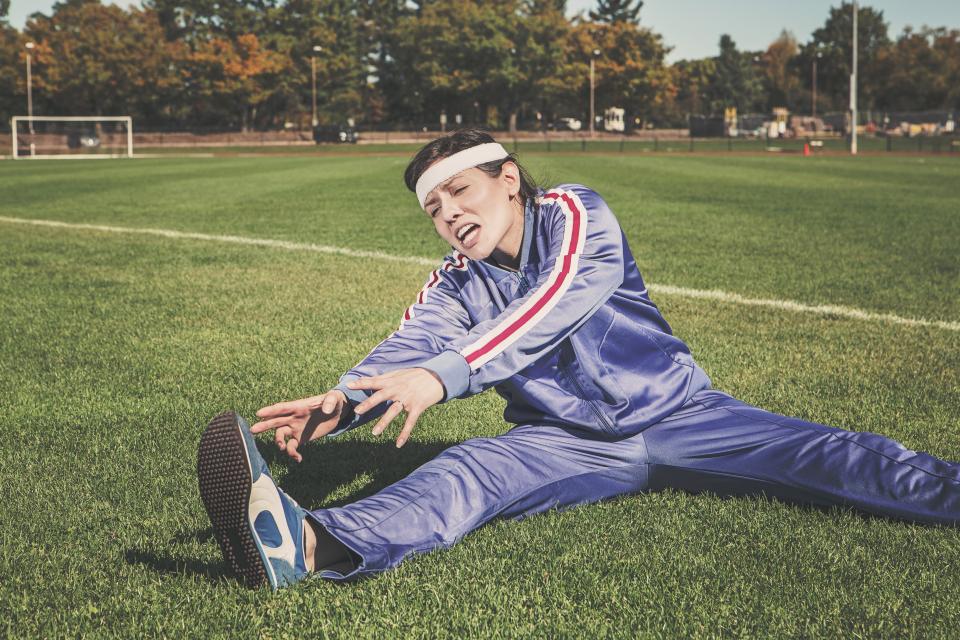

Some People Will Never Walk Into a Studio
There is a large group of people who would benefit from regular stretching and mobility work and who will never, under any circumstances, sign up for a yoga class. They are not being stubborn. They have looked at the photographs on the website, worked out that everybody there will already know what they are doing, and decided the whole thing is not for them.
A park changes that calculation completely. It is free, or nearly. Nobody is watching from a reception desk. You can stand at the back near the path and leave whenever you like. For a certain kind of person — often the ones who would benefit most — the outdoors is not a nicer version of the studio. It is the only version they will actually attend.
Why Outside Works Better for Some People
- There is no threshold to cross. Walking into a building, past a desk, into a room of regulars is the hardest part of any class. In a park you simply drift over, and drifting away again is equally easy.
- Mirrors are absent. Studios often have full walls of them, which for anyone self-conscious about their body is the single biggest deterrent. Grass has no mirrors.
- The cost barrier disappears. A public park session with a volunteer or a low-cost instructor removes the membership, the class card, and the pressure to buy equipment.
- Fresh air suits people who overheat. Warm studios are genuinely difficult for some people, including many going through menopause and anyone with certain health conditions.
- It combines with things people already do. Fifteen minutes of mobility at the end of a walking group session reaches people who would never attend a standalone class.
- Attention goes outward. Trees, sky, birds. People who find lying still with their eyes closed indoors uncomfortable often manage it easily outside.
None of this means outside is better. Rain, cold ground, uneven surfaces and dog walkers are real drawbacks, and some people much prefer a warm room. It means the outdoors reaches a different set of people, which is the whole point for a community group.
What Mobility Work Actually Does
It is worth being straight about this, because stretching is surrounded by claims that are stronger than the evidence behind them.
What is reasonably well supported
Regular stretching increases how far a joint can move and how comfortable it feels near the end of that range. People who work at it become able to reach, twist, squat and turn more easily, and that translates directly into everyday tasks: getting off the floor, looking over a shoulder while driving, putting a coat on. Practices like yoga combine that range of motion work with balance, breathing and strength, and balance training in particular has good support for reducing fall risk in older adults.
People also very consistently report feeling better afterwards. That is worth taking seriously even where the mechanism is unclear.
What is uncertain or overstated
Stretching before exercise has not been shown to reliably prevent injuries, and long static stretches immediately before a strength or sprint effort may temporarily reduce power output. A gentle moving warm-up is usually a better choice before activity, with longer stretches afterwards or in a separate session.
Stretching does not lengthen muscles permanently, does not remove lactic acid, and does not reliably prevent next-day soreness. Claims about detoxification, realignment or organ health should be treated with skepticism.
None of this is medical advice. Anyone with a recent injury, joint replacement, osteoporosis, uncontrolled blood pressure, balance problems or a condition affecting connective tissue should check with their doctor or a physical therapist about which movements are appropriate for them, and should tell whoever is running the session.
Running a Session for Mixed Ages and Abilities
A park session will bring you a seventy-eight-year-old with a hip replacement, a marathon runner, someone recovering from surgery, and a teenager who came with their grandmother. The instinct is to aim for the middle. It is better to design so that every movement has three versions.
- Offer every movement at three levels. Announce them at the same time and in the same tone, so the easier version is a choice rather than a concession. "Hands on the bench, hands on your thighs, or hands to the ground — all of these are the same exercise."
- Cue by sensation, not by shape. "Until you feel a gentle stretch down the back of your leg" works for every body in the group. "Touch your toes" works for a few and excludes the rest.
- Say out loud that pain is a stop signal. A mild pulling sensation is normal. Sharp, pinching or radiating pain is not, and people need permission to come out of a position.
- Do not physically adjust people. Correct with words. Hands-on adjustment requires training and consent, and in a casual community setting it is better avoided entirely.
- Move slowly between positions. Getting up and down is where the risk sits, particularly for older participants, and rushing transitions is what causes dizziness.
- Keep everyone facing the same way. People at the back copy people at the front. Placing yourself so nobody has to twist around to see you removes a lot of confusion.
Adapting for People Who Cannot Get to the Floor
A great many people cannot get down to the ground, or can get down but not back up, or find kneeling painful. This is common and it should not require anybody to announce it.
The simplest fix is to run the whole session standing and seated as the default, with floor work offered as an option rather than the base plan. Almost everything worth doing has a standing or seated version.
- Use benches, walls and tables. A park bench substitutes for the floor in a huge range of positions, and a wall provides support for balance work and shoulder stretches.
- Bring folding chairs. A stable chair without arms opens up seated versions of most twists, side bends, hamstring stretches and breathing work.
- Offer support for anything on one leg. A hand on a bench or a partner’s shoulder makes balance work accessible without singling anybody out.
- Watch the surface. Look for flat, dry, level ground. A slope changes balance work considerably, and wet grass is slippery underfoot.
- Say the options before people commit. Announcing the seated version first, and doing it yourself sometimes, stops it reading as the lesser option.
The Practical Side of an Outdoor Session
Cold muscles and cold ground are the main enemies. Start with five minutes of walking and gentle arm swings before anything held. Tell people to bring a mat or a towel, and keep a few spares, since dew survives long after the rain has stopped. Sit on something insulating rather than directly on cold ground.
Pick a spot with some shelter from the wind and shade in summer, and be honest about your weather policy in advance so nobody stands in a park wondering whether it is cancelled. Sessions of thirty to forty-five minutes suit outdoor conditions better than an hour.
Voices carry badly outdoors, so stand upwind, speak slowly, and keep the group in a horseshoe rather than a long line. Demonstrate more than you describe.
Start With Fifteen Minutes on the End of Something Else
If you are thinking of running something, the easiest starting point is not a new class. It is a quarter of an hour bolted onto an activity that already exists — after the walking group, before the community garden session, at the end of a family morning in the park.
People who would never sign up for yoga will happily stay for fifteen minutes with people they have just walked with. Some of them will discover that being able to reach their own feet again is worth more to them than they expected. That is a better result than a beautifully planned class nobody attends.
