

The best yard games for a mixed group are the ones a newcomer can understand in a minute and play reasonably well on the first try. This guide explains how to choose, how to adapt the rules, and how to turn a few games into a regular gathering.
What makes a yard game work for a mixed group?
When you are choosing for a group, ignore the novelty and ask three questions. Can a first-timer play after one demonstration? Can people of different ages and strength play on the same side? Can it be set up quickly and carried by one person? Games that pass all three tests are the ones that keep a gathering moving instead of leaving half the group watching.
The appeal is broader than exercise. Outdoor games encourage friendly competition and screen-free time, and they bring different generations onto the same patch of grass. For a community organisation, that is the real value: a low-barrier reason for people who would not sign up for a fitness class to show up and stay.
Beyond simplicity, look for games where skill matters but strength does not. A heavy ball tossed gently can be just as accurate coming from a seven-year-old as from a competitive adult, and that evenness is what keeps everyone engaged.
Which games suit uneven grass, and how much space do they need?
A park lawn is rarely flat, so favour games that tolerate bumps or that you can place on the best patch you can find. Here is how the most reliable options compare for a group setting.
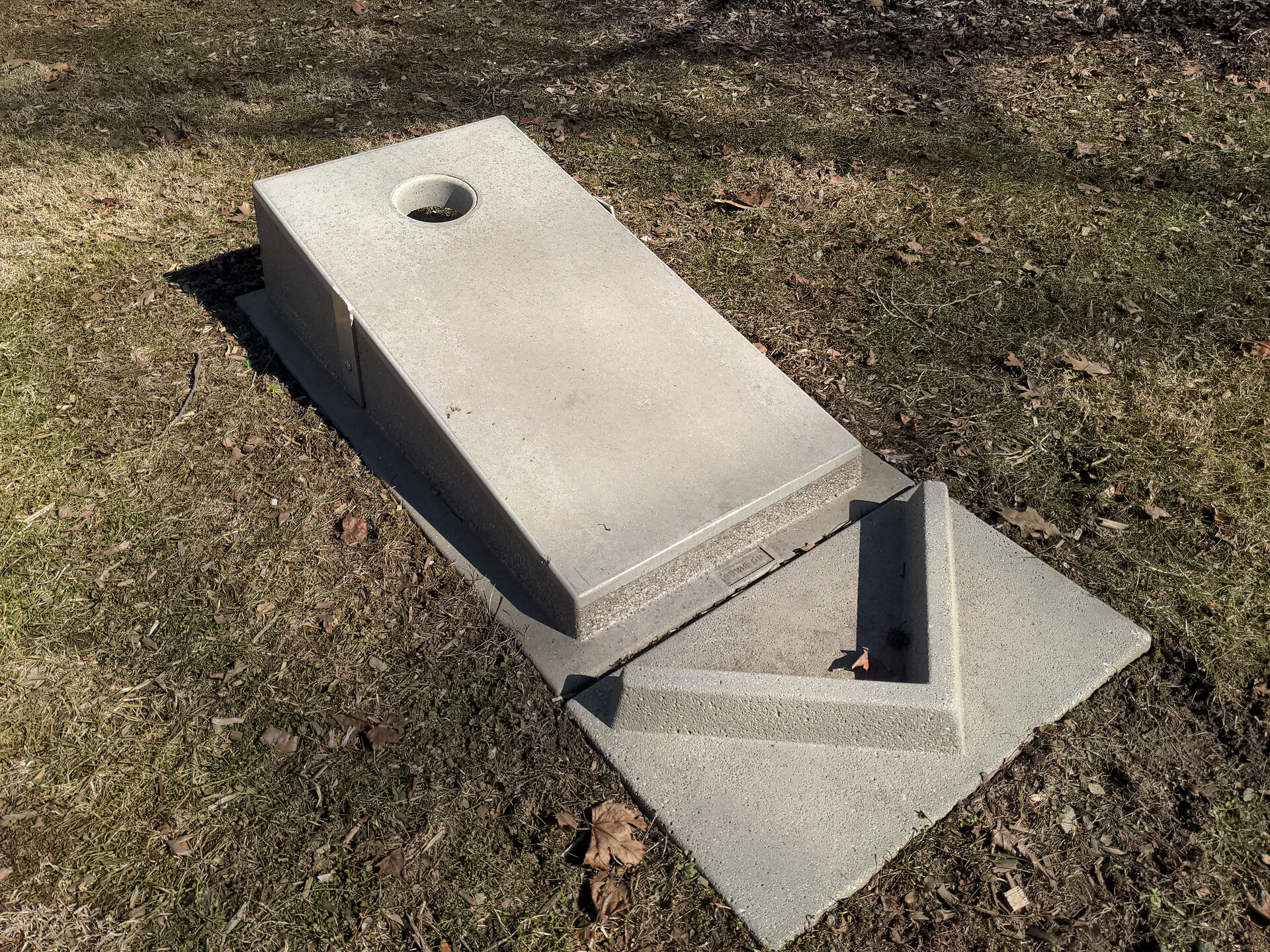
- Cornhole: players toss bean bags at an angled board with a hole in it. The boards sit on their own legs, so a slightly uneven spot is usually workable. Give the two boards a clear lane between them and a little room behind each for people to stand.
- Ladder toss: you throw bolas, two balls joined by a string, at a three-rung ladder, with each rung scoring differently. The ladder stands by itself, so it copes well with imperfect ground, and it takes up little space.
- Horseshoes: metal horseshoes are tossed at a stake, and the setup works on grass, dirt or sand. That flexibility makes it a sensible choice when you do not know what the ground will be like.
- Bocce: balls are tossed to land as close as possible to a smaller target ball called the pallino. Bumps will affect how the balls roll, so pick the smoothest strip you can find and treat the unpredictable bounces as part of the fun.
- Kubb: a thrown-baton game that is also played on grass. The supplied sources do not cover its rules or dimensions, so check the instructions that come with any set before you plan around it.
Before anyone plays, walk the lawn and pick the flattest, driest area. Clear sticks and stones, and keep throwing lanes well away from paths, picnic tables and spectators.
How do you adapt the rules for children and older adults?
Mixed-age play rarely needs new games. It needs small changes to distance, scoring and teams, and these work across most of the options above.
Make it fair, not identical
- Shorten the distance for younger players. Let children throw from a closer line while adults keep the standard one, so everyone faces a similar challenge.
- Mix the teams. Pair a child or an older adult with a more experienced player and score as a team. It spreads the pressure and gives people someone to learn from.
- Simplify scoring. If counting points slows the game down, play first to a small number or just count who lands closest.
- Keep the pace gentle. Let people sit between turns and let anyone throw underhand or from a chair if that suits them better.
Choose low-impact games first
It involves real skill in tossing the heavy balls accurately, yet young children can still play successfully, and its low impact makes it a good choice for grandparents and great-grandparents.
Treat the high-intensity games with care
Fast, athletic games can be hard to play with younger children and are better kept for older teens and adults who want a workout. If you are offering those, have them as an optional extra rather than the centrepiece of the afternoon. For anything involving discs thrown at speed, flexible discs are a safer choice around kids, since a stray throw is less likely to hurt anyone.
How much should a starter set cost, and what should you buy first?
For a community organisation, the sensible approach is to start small and add games once you see which ones people choose.
Several decisions affect the price and how well a set holds up:
- Portable or permanent. Cornhole, for example, is sold in smaller tailgate sizes and in regulation size, and you can find collapsible, compact sets as well as solid wood ones. If equipment will be carried to a park each week, portability is worth paying for.
- Build it yourself. Some games, including cornhole boards and certain ring-toss games, can be made as a DIY project. That can lower costs and works well as a volunteer activity, as long as the finished boards are sturdy and safe to use.
- Combination sets. Some products bundle a folding table with cornhole and ladder toss in one portable kit, which cuts down on the number of things you have to carry.
A practical first purchase is two or three games from different categories: one tossing game, one lawn game with a little strategy, and something that allows a bigger group to play at once. That gives you variety without a large outlay, and it lets you learn what your group enjoys before committing more of the budget.
How do you turn a few games into a weekly gathering?
A one-off game day is pleasant. A recurring one builds a community. The trick is to make it so easy to run that it keeps happening.
Keep setup short
Aim to have everything out and playable in under ten minutes. Store the equipment in one or two bags or bins, keep the rules for each game on a card, and choose a regular spot so people always know where to find you. Ask early arrivals to help set up, which makes helpers feel like hosts.
Rotate the games
Set up three or four stations and let people drift between them. Changing the lineup from week to week keeps regulars interested, and having several stations means no one has to wait long for a turn. Rotating also lets you see which games draw the biggest crowds, which tells you what to buy next.
Make it easy to join
- Put a person at the entrance who can explain the games in a sentence or two.
- Offer a seated station with a game people can play without standing for long.
- Bring shade and water in hot weather, and have a plan for rain.
- Run informal mini-tournaments now and then, since friendly competition adds energy without excluding anyone.
Over time, the same faces return and bring friends, and the afternoon starts to work as an anchor for other outdoor activities, such as walks, picnics or volunteer days.
Frequently asked questions
What is the easiest yard game to start with?
Cornhole and bocce are two of the simplest. Cornhole is easy to learn and works for all ages, and bocce is low impact and lets young children play with success. Either one can be explained in under a minute.
Can yard games be played on uneven grass?
Many can, though results vary. Horseshoes works on grass, dirt or sand, and freestanding games like cornhole and ladder toss can be placed on the best patch available. Rolling games such as bocce are more affected by bumps, so choose the smoothest area you can find.
How do you keep children and older adults on equal footing?
Use mixed teams, shorter throwing distances for younger players, and simple scoring. Choose low-impact games such as bocce, and keep fast, athletic games as an optional extra for those who want a workout.
How much does a starter set cost?
Plan on about $40 to $120 per game for a typical community starter set, depending on size, materials and portability. Building some games yourself can reduce the cost if you have volunteers who enjoy simple woodworking.
Related reading
- Going Out Anyway: How to Handle Bad Weather Outdoors
- What Is a DNR Outdoor Adventure Center and How to Use One: A Complete Guide
Sources
- Best Yard Games: 9 Our Family of 9 Actually Plays (thetabletopfamily.com, accessed 2026-11-09)
- The Best Outdoor Games To Play With Family And Friends (lifetime.com, accessed 2026-11-09)
Photo: Concrete cornhole board, by Jleedev, CC0 (Wikimedia Commons)

